
If you’ve ever been mid-conversation and suddenly received a text that just says “TSTS,” you’ve probably paused and thought, wait, what does that even mean? You’re not alone. This little four-letter combo has been popping up more and more in group chats, comment sections, and DMs, leaving a lot of people scratching their heads.
The truth is, TSTS doesn’t have one fixed definition. It shifts depending on who’s typing it, what platform they’re on, and the mood of the conversation. In this guide, we’ll break down every common meaning of TSTS, where it likely came from, how to use it correctly, and how to reply when someone drops it in your chat. By the end, you’ll never have to guess again.
What Does TSTS Mean in Text?
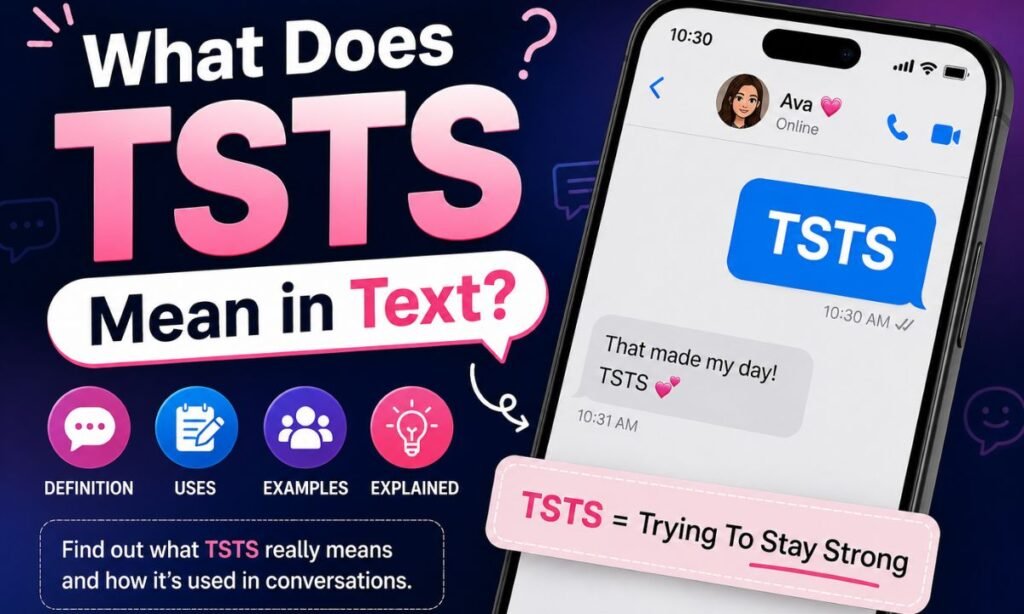
At its core, TSTS is a texting abbreviation that people use as a quick reaction rather than a full explanation. It’s one of those slang terms that carries emotion and tone without spelling everything out.
Depending on the context, TSTS commonly stands for:
- Too Smart To Say – used when someone wants to hint that they already know the answer but won’t say it out loud
- Too Stressed To Speak – used to express emotional overwhelm or exhaustion
- Too Shy To Say – used when someone is holding back out of nervousness
- Too Soon To Say – used to express uncertainty about a decision or outcome
- That’s So True (sometimes written as a playful agreement) – used to strongly agree with a statement
Because it can shift meaning so easily, TSTS is often described as a “mood-based” abbreviation. It’s less about a literal phrase and more about the vibe the sender is trying to convey in that exact moment. This is also why context clues like the message before it, the emojis used, and the relationship between the two texters matter so much when decoding it.
Tsts meaning in chat
In everyday chat apps like WhatsApp, iMessage, and Instagram DMs, TSTS usually functions as a short, casual reply rather than a conversation starter. People rarely open with it; instead, it shows up as a response to a question or comment.
For example, someone might ask a friend for advice, and instead of giving a straight answer, the friend replies “tsts” to playfully avoid committing to an opinion. In more emotional chats, the same abbreviation can appear when someone doesn’t have the energy to explain how they’re feeling and wants a way to signal that without writing paragraphs.
In group chats specifically, TSTS often works as a quick reaction to something funny, dramatic, or slightly outrageous similar to how people use “lol” or “same” as filler reactions that keep the conversation moving without adding much new information.
The Origin of TSTS in Texting
There’s no single, well-documented moment where TSTS was “invented.” Like most internet slang, it appears to have developed gradually across group chats, gaming communities, and social platforms rather than being coined by one person or brand.
A few things likely contributed to its rise:
- The texting culture of abbreviation. Just like LOL, BRB, and OMG became shorthand for longer phrases, TSTS follows the same pattern of shrinking a sentence into a handful of letters.
- The need for fast emotional reactions. Text messages lack tone of voice and facial expressions, so short reaction-based slang like TSTS helps fill that emotional gap quickly.
- Gen Z’s love of ambiguous, flexible slang. Many newer slang terms are intentionally vague, allowing them to be reused across different situations which is part of why TSTS caught on with younger texters especially.
Because it wasn’t tied to one platform or trend, TSTS spread more like a habit than a viral moment, which explains why its meaning still varies from group to group.
TSTS meaning in text from a girl
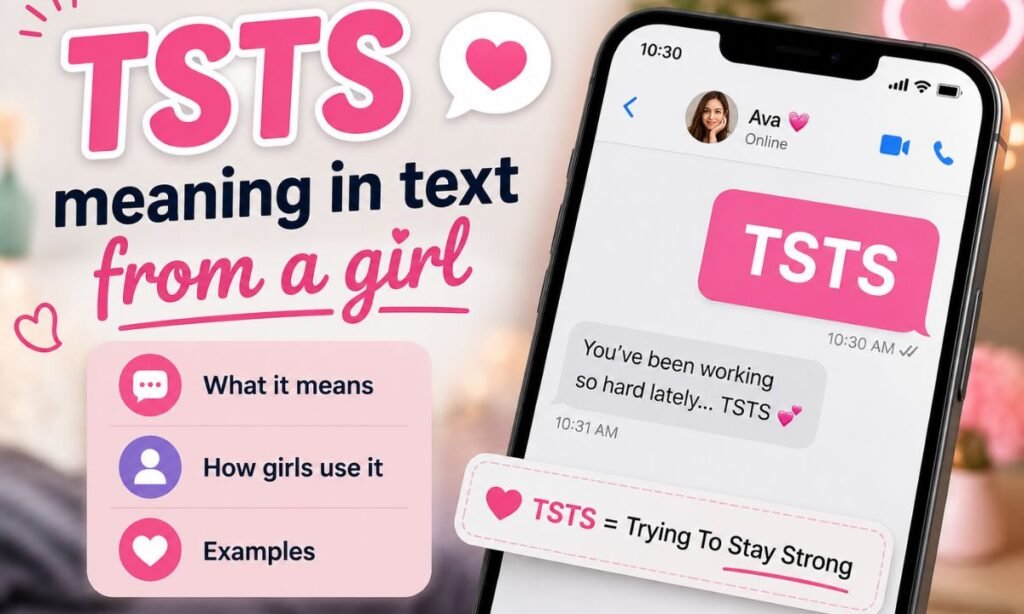
When TSTS shows up in a message from a girl, it’s usually tied to emotional nuance rather than pure information-sharing. A few common interpretations include:
- She’s hinting at something she doesn’t want to spell out directly (playful or flirty context)
- She’s feeling overwhelmed and doesn’t want to unpack it fully right now
- She’s giving a lighthearted non-answer to avoid an awkward or loaded question
As with most texting slang, tone matters far more than the letters themselves. A “TSTS 😉” after a teasing question reads very differently from a plain “tsts” sent after a heavy or emotional topic. If you’re unsure, the safest move is to look at the conversation leading up to it rather than assuming the worst or the best case scenario.
Different Meanings of TSTS Explained
Since TSTS isn’t standardized, it helps to see the possible meanings side by side. Here’s a simple breakdown:
| Meaning | Typical Tone | Common Use Case |
| Too Smart To Say | Playful, teasing | Avoiding an obvious answer |
| Too Stressed To Speak | Emotional, tired | Signaling overwhelm without explaining |
| Too Shy To Say | Nervous, soft | Holding back a confession or opinion |
| Too Soon To Say | Uncertain, neutral | Responding to “what’s next” type questions |
| That’s So True | Agreeable, casual | Reacting to a relatable statement |
| Typo for “tests” | Accidental | Missing a letter while typing quickly |
That last one is worth remembering sometimes TSTS isn’t slang at all. It’s simply a typing mistake where the “e” in “tests” got dropped. Before reading too much into a message, it’s worth checking whether the rest of the sentence makes more sense with “tests” instead.
Why TSTS Is Becoming Popular
Slang trends rise and fall constantly, but a few reasons explain why TSTS has stuck around longer than some other short-lived terms:
- It’s flexible. One abbreviation can express several emotions, so people don’t need to remember multiple acronyms for similar situations.
- It saves time. Typing four letters is faster than writing a full sentence, especially during quick back-and-forth conversations.
- It fits Gen Z texting culture. Younger users tend to favor slang that feels casual, slightly mysterious, and open to interpretation rather than blunt or overly literal.
- It works across platforms. The same abbreviation can be used in texts, comments, captions, and DMs without needing to be adjusted for the platform.
Its popularity isn’t explosive like some viral trends it’s more of a steady, word-of-mouth spread through everyday conversations, which tends to make slang last longer overall.
How to Identify the Correct Meaning of TSTS
Because TSTS can mean several different things, the best way to interpret it is by paying attention to context. Here’s a simple checklist:
- Look at the question or statement before it. TSTS almost always responds to something specific.
- Check for emojis or punctuation. A winking emoji suggests playfulness, while a plain “tsts” with no punctuation can feel more neutral or flat.
- Consider the relationship. Close friends and romantic interests tend to use it more playfully, while acquaintances might use it more literally.
- Notice the topic. Emotional topics point toward “too stressed to speak,” while lighter topics usually mean “too smart to say” or “too soon to say.”
- Watch for spelling patterns nearby. If other words in the message look rushed or misspelled, TSTS might simply be a typo for “tests.”
Following this quick mental checklist prevents most of the confusion people run into when they see TSTS for the first time.
Examples of TSTS in Text Conversations
Seeing TSTS used in real conversations makes the meaning much clearer. Here are a few sample exchanges:
Example 1 Playful avoidance
Alex: Wait, do you actually like him? Sam: tsts 👀
Example 2 Emotional exhaustion
Jordan: You’ve been quiet all day, everything okay? Taylor: tsts… long day
Example 3 Uncertainty
Mia: Are we still on for Friday? Chris: tsts, depends on work
Example 4 Agreement
Priya: This class is way too early for a Monday Dev: tsts fr
Each of these examples shows how the same four letters shift meaning depending entirely on the sentence right before it which is exactly why context is the real key to understanding TSTS.
TSTS on Social Media Platforms
Outside of one-on-one texting, TSTS also shows up frequently in comment sections, captions, and reaction threads. On social media, it tends to work less like a personal reply and more like a quick public reaction similar to typing “same” or “lol” under a relatable post.
It’s especially common on platforms where fast, casual reactions are the norm, and where users are replying to short-form content rather than long messages. Because comment sections move quickly, short slang like TSTS helps users react without slowing down the scroll.
Tsts meaning in snapchat
On Snapchat, TSTS is typically used the same way it’s used in regular texting as a quick, casual reaction to a snap or a chat message. Since Snapchat conversations tend to be fast, informal, and disappear after viewing, users often lean on short slang like TSTS instead of typing out full responses.
It’s commonly seen in:
- Replies to a snap where the sender doesn’t want to give a full explanation
- Quick reactions to a story that felt relatable or funny
- Casual chat replies between close friends who already understand each other’s texting style
Because Snapchat conversations are often more intimate and inside-joke driven, TSTS on this platform leans more toward playful or teasing meanings rather than formal or literal ones.
What does TSTS mean on tiktok
On TikTok, TSTS usually appears in the comment section rather than in direct messages. It’s often used as a reaction to a video that feels relatable, dramatic, or slightly controversial similar to leaving “the way I felt this” under a clip.
In some cases, TikTok users also repeat the term as “ts ts” to add emphasis, almost like a judgmental or sarcastic sound effect. This repeated version tends to carry a stronger tone than the standard four-letter TSTS, often expressing mock disapproval or exaggerated reaction rather than a literal statement.
When to Use TSTS in Texting
TSTS works best in low-stakes, casual conversations where a short reaction fits naturally. Good moments to use it include:
- Responding playfully to a teasing question
- Reacting to something relatable without needing to elaborate
- Giving a light, non-committal answer in a casual chat
- Adding a quick agreement to something someone said
In these situations, TSTS keeps the conversation light and fast without requiring a full explanation.
When NOT to Use TSTS
There are also situations where TSTS can easily be misread or come across the wrong way. It’s best avoided when:
- The conversation is serious, emotional, or sensitive a vague reply can feel dismissive
- You’re texting someone unfamiliar with texting slang, since they may not understand it at all
- Clear communication really matters, such as in work-related or important personal conversations
- The other person has directly asked for a real answer, since TSTS can feel like you’re dodging the question
In these cases, spelling out your actual thought is almost always the safer and more respectful choice.
How to Respond to TSTS in Text
If someone sends you a plain “TSTS,” the best reply depends on the tone of the conversation:
- If it feels playful: Reply with something like “haha okay, spill it” to keep the teasing going.
- If it feels mysterious: A curious response like “now I really want to know” fits naturally.
- If it feels emotional: A supportive message such as “hey, I’m here if you want to talk” is a better fit than joking around.
- If you’re unsure: Simply asking “wait, what do you mean by that?” is always a safe, low-pressure option.
Matching your tone to theirs is the easiest way to keep the conversation flowing smoothly.
Common Misunderstandings About TSTS
A few mix-ups happen often when people first encounter TSTS:
- Assuming it always means the same thing. Since it changes by context, treating it as a fixed phrase leads to confusion.
- Confusing it with a typo. Sometimes it really is just “tests” missing a letter, not slang at all.
- Reading it as rude when it’s meant to be playful. The “too smart to say” version can sound arrogant out of context, even when it’s intended as a joke.
- Overthinking a simple reaction. In many cases, TSTS is just filler slang without any deep hidden meaning.
Being aware of these common mix-ups makes it much easier to interpret TSTS correctly the first time you see it.
TSTS vs Other Similar Slang Terms
TSTS is often confused with a few other short texting terms. Here’s how they compare:
| Term | Meaning | How It Differs From TSTS |
| TS | Short for “that’s” or used to express strong disapproval | More blunt and direct than TSTS |
| TBTS | “Throwback to something” | Refers to nostalgia, unrelated to reactions |
| NGL | “Not gonna lie” | Used to preface an honest opinion, not to avoid one |
| IYKYK | “If you know, you know” | Signals an inside joke rather than hesitation |
| Ts ts (repeated) | Exaggerated judgmental reaction | Stronger, more sarcastic tone than a single TSTS |
Understanding these differences helps prevent mixing up TSTS with terms that look similar but carry a completely different tone.
Final Words
TSTS is one of those texting abbreviations that proves slang doesn’t always need a single, fixed definition to be useful. Whether it means “too smart to say,” “too stressed to speak,” “too shy to say,” or simply a rushed typo for “tests,” its real meaning almost always comes from the context surrounding it rather than the letters themselves.
The next time TSTS shows up in your messages, take a second to look at the conversation around it the tone, the emojis, and the relationship between you and the sender. Once you get comfortable reading those context clues, decoding TSTS becomes second nature, and you’ll never be left wondering what it means again.
FAQs
What does TSTS mean in a text message? It’s a flexible slang term that can mean “too smart to say,” “too stressed to speak,” “too shy to say,” or “too soon to say,” depending on context.
Is TSTS always slang? No. Sometimes it’s simply a typo for “tests” where the letter “e” was accidentally left out.
Is TSTS rude to say? It can come across as dismissive in serious conversations, so it’s best used casually and avoided in sensitive discussions.
Does TSTS mean the same thing on every platform? Not exactly. On Snapchat and in texts it’s usually personal and playful, while on TikTok it often appears as a public comment reaction.
How should I reply to TSTS? Match the tone of the conversation playful for teasing, curious for mystery, and supportive if it seems tied to stress or emotion.
What’s the difference between TSTS and TS? TS is usually more blunt and used to express disapproval, while TSTS carries a softer, more varied range of meanings.